
Hunting Hardware
This post is the fifth in a series of posts about the sport of curling.
We began 2017-2018 by winning the first spiel of the season, the Philly Back-to-School spiel. This event was hosted yearly by our good friends from Penn and Villanova, and it was such a great relief to finally win a spiel. It was also made just a little bit sweeter because we defeated RPI in the final, who had already beaten us in two previous A finals, including the last spiel of the 2016-2017 season.

The team after our club's first ever spiel win at Philly, October 2017 (which explains the Halloween pants, as much as they could be explained). Left to right: Greg, Xiang, me, Patrick.
But the Philly spiel only hosted 8 teams (since the club only has two sheets of ice), so while it was a statement, we still had a lot of work to do to get ready for Nationals that Spring. After that result, it would have been easy to focus on getting as many results as possible that year in a push to finally medal at Nationals. But this would have been in direct conflict with one of the core ethos of our club: to prioritize learning and experience for our newer members. I'm proud to say that we stuck to our roots in that regard, and continued to mix teams up and play less experienced curlers at spiels, rarely sending a "loaded" team. We knew that kind of play would do much more for the club in the long term than any short term gratification of winning a few spiels would.
And yet, we still found ways to pull off a couple more A event wins that season. We won the Crash Spiel at Belfast (which was really satisfying, as that was the spiel where we had our first event win, and was my favorite spiel of the year) as well as the Cape Cod spiel, both hosted by Bowdoin. At the rest of the spiels, we played on Sunday every weekend, and made an event final each time, winning many of them. Importantly, we hit our stride as just the right time (again) at Utica in the last spiel of the season, winning the B event (lost our first game and then won the rest).

The team arriving at Nationals, excited to compete. Left to right: Xiang, Patrick, Greg, me, Fabian.
Going into Nationals, we were certainly one of the favorites to make the final 8 and have a chance to win hardware. We were the top seed in our group, and knew that we had a very good shot at winning it. But as fate would have it, we struggled to adjust to the ice in the first game, and our friends from Harvard played very well to beat us in a nail-biter. I came off of the ice furious, having flashbacks to previous Nationals where we had always come up just short. It seemed like we had just thrown away our four years of work in a matter of two hours. It took all I had not to scream.

A split team we put together with two Harvard curlers for the RPI spiel in 2017; we won the D-event that weekend. Left to right: Fabian, me, Jack, Jules.
Technically, it was not over, and after I cooled off, I focused on gathering my team and rallying them. We could still win the pool, and even though we didn't necessarily control our own destiny at that point, if we were really one of the top teams in the country, then now was the time to show it.
As fate would have it, I had worked hard as part of the College Curling Advisory Board to USA Curling to help reorganize the Championship format, because the old system just had not made sense. Previously, teams would play a round robin in pools of four, and then would be seeded into new pools of four based on those results. The new pools would then play for 1st/2nd, 3rd, 4th, and 5th respectively. That system had made no sense for a number of reasons, but the most important one was that a team who went 3-0 in pool play and then lost to only the eventual National Champion received no recognition, whereas a team that went 0-3 in pool play and then beat two other teams who also went 0-3, was awarded 5th. I'd been promoting this since I had joined the board in 2015, but had become even more insistent after falling prey to the previous system's deficiencies in 2017, when exactly the scenario I named above had happened to us.
The new format seeded the eight best teams after round robin play, and they then played a ranked tournament (1 vs 8, 2 vs 7, 3 vs 6, 4 vs 5) for the title. Of course, winning your pool was the only surefire way to get to the final 8, but the system assured a way for teams to survive tough pool matchups to have a shot at redemption (so that the three best teams could win the three top spots).
So, we got to work. We still struggled in our next game against Hamilton, but the tide turned in a rather unusual way. One of the quirks of curling is that you self-referee on the ice. Curlers are expected to be truthful when they violate rules and to penalize themselves accordingly. In addition, competitors have an expectation of interpreting the rules fairly when their opponent makes an infraction. One such incident occurred during that game, where one of the Hamilton curlers hit the rock with their broom while sweeping (termed "burning" the rock). The rules indicate that if a rock is burned after a certain line on the ice (the Hog line), the rock should be allowed to come to rest. Then, the opposing skip (captain) would decide whether:
The rock is removed from play and all rocks it touched are returned to where they had been before the shot,
All rocks are left where they stopped, or
Rock(s) are placed where they reasonably would have ended by the opposing skip.
This is a difficult rule, because the interpretations vary widely in their effect on the game. The most hardnosed (#1) is pretty cut and dry, but also widely criticized as least in the "spirit" of the game (the "spirit of curling" is an ethos of fair play and sportsmanship that is foundational to the game). #2 is easiest, but can put the opposing skip in a compromising position if the result of the burned rock would not have likely occurred without the burn, because a big deflection can really change the result. Finally, #3 is the most variable because it is the hardest to implement, often requiring moving multiple stones to new places on or off the ice, guessing at their eventual locations, and this can lead to significant benefit to one team over the other. Overall, this rule has led to many headaches throughout the years, perhaps most famously at the 2018 Olympics.
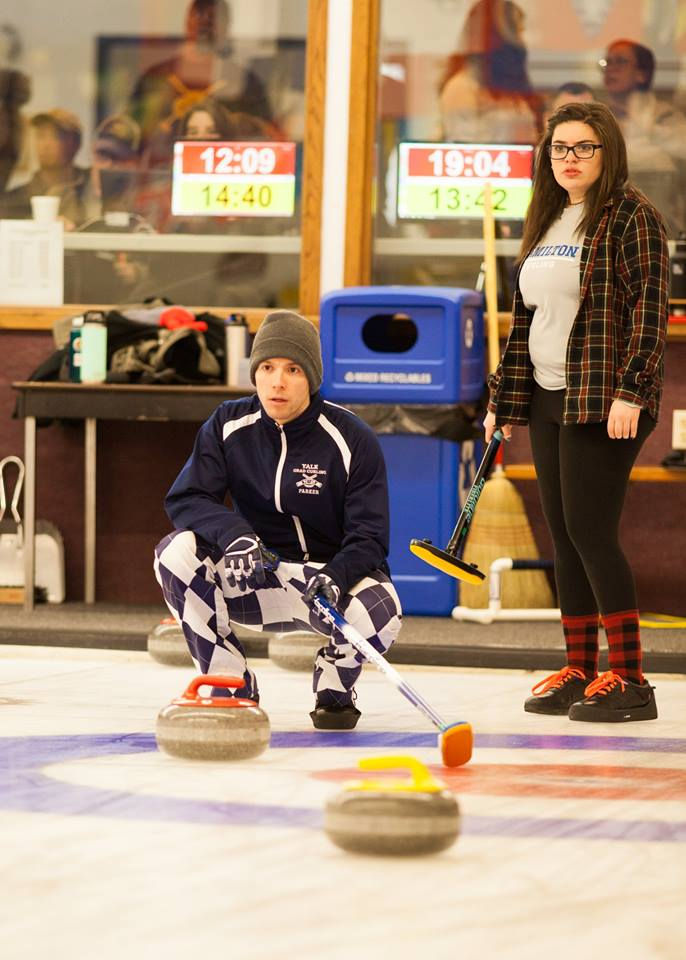
Action from the Hamilton game at Nationals, 2018. Left to right: Me, Neely.
So there I was, in a tight game at Nationals, feeling the pressure to finally pull our team to a medal, met with this situation. The Hamilton skip had made a very nice shot - I was sure that it would have been closest to the center of the rings (and therefore, they would be likely to score that end). And because I was sure, after the stones stopped, I took the stone she had thrown and placed it where I assume it would have finished - right behind guards in the center of the house. I then went down the ice to play my next shot.
Based on the rules, I had every right to remove the stone from play, or to rearrange stones (within reason) to our advantage. But that would not have been in the spirit of the game, or sportsmanlike, or right. It would have been easy to let the competition blind me from that, and I'm glad that I did not let it. Whatever the outcome would be, I would leave that game knowing that I had done the right thing.
Hamilton ended up scoring that end, but the decision I made seemed to give my team new energy and motivation. We went on to win the game convincingly to put ourselves in a position to possibly make the final 8. In our next game, we played even better, winning easily against a very good team from UW Green Bay. And just like that, we had bounced back to win the group and make the Championship bracket as the 7th seed. The hunt for hardware was on.
Next week's installment will continue with final results of the 2017-2018 season, the last of the author's time in graduate school.


Comments